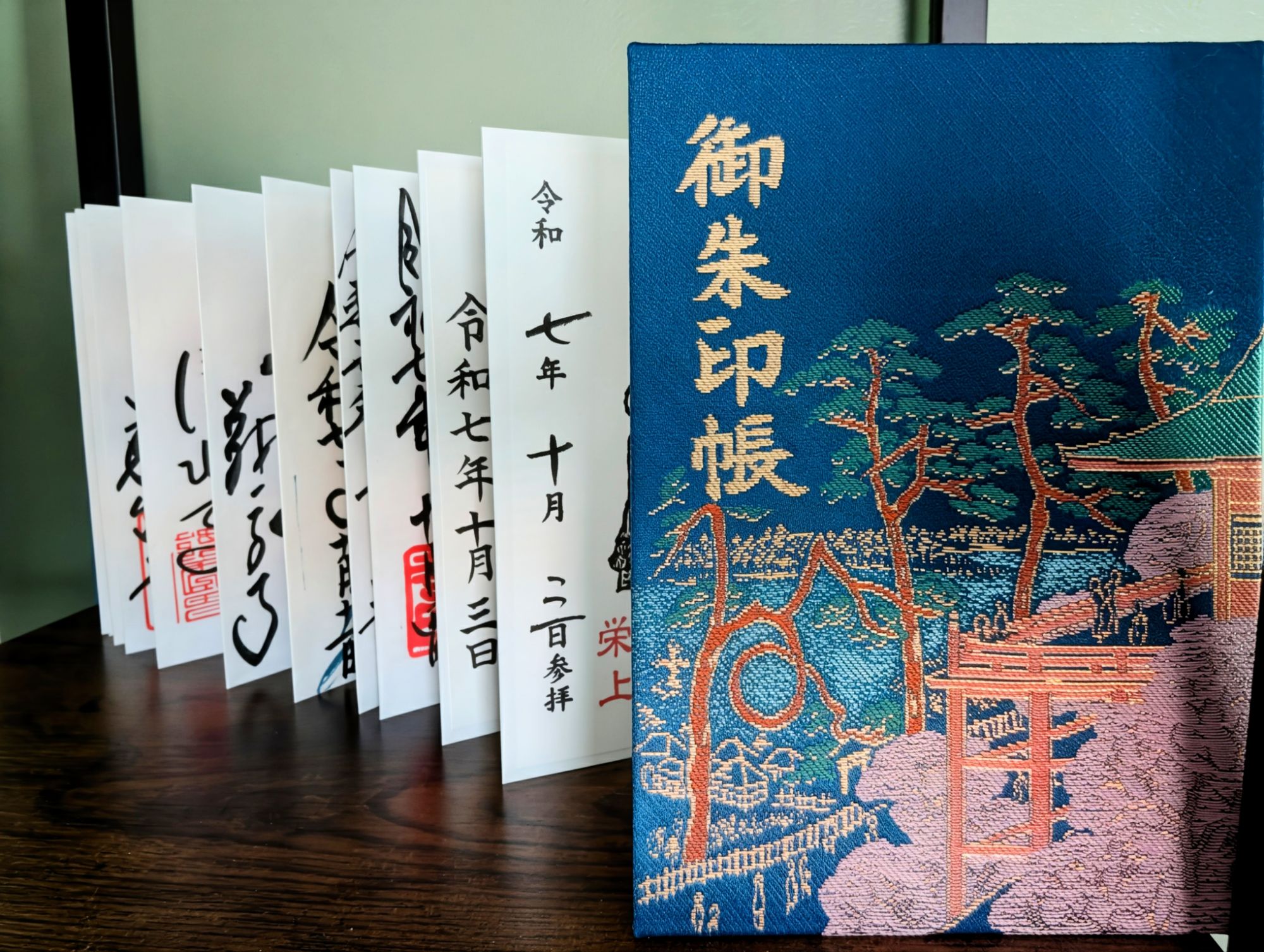
If part of your trip to Japan includes visiting the local temples and shrines, as it should, you should also consider collecting the Japanese goshuin from each one you go to. Not only does it encourage you to visit shrines and temples off the beaten path you may not otherwise go to, but you get a souvenir at the end of it that makes for a beautiful display and is a unique representation of your trip, and your trip alone. No one will have the exact same souvenir as you, because each goshuin is individual, and most are hand-drawn.


So what exactly are goshuin and what do you need to know to start collecting them during your Japan trip? Let’s get into it!
What Are Japanese Goshuin?
Japanese goshuin stamps are unique seals that you can collect at most, if not all, Buddhist temples and Shinto shrines throughout all of Japan. Every temple and shrine has its own individual style, with a certain stamp representing that specific location that they then write their kanji over, including the date of your visit. The stamps act as something of an attendance record, showing you actually went there, while also serving as a bit of a spiritual souvenir representing your pilgrimage throughout Japan. They also are considered sacred, blessed by the priests/priestesses or monks.
Because each location’s stamp is unique to that temple, and you’re likely not going to the exact same temples as every other visitor, this means your collection is going to be unlike anyone else’s, and specific just to that one visit in Japan. That’s what makes it the perfect souvenir!


What AREN’T Japanese Goshuin?
You may have heard of stamp rallies in Japan. These are stamps you can collect at different sites, and often feature a cute cartoon animal or character. These are NOT goshuin, and should not be in the same book with your actual goshuin. Keep in mind that these are supposed to be representations of your spiritual journey throughout Japan, a respectful mark of your visits to these sacred places. So that stamp of a cartoon tanuki, while adorable, does not belong alongside the actual goshuin. Please make sure you have a separate book for those stamps if you plan to participate in a stamp rally.
What do I need to collect goshuin in?
Most larger temples and shrines will sell goshuincho. This is the accordion-style book that they will either draw your stamps in directly, or they will provide you with a loose slip of paper with the stamp that you then paste into the book yourself. The goshuincho books themselves are beautiful and ornate, and usually have a cover representing the temple or shrine. We saw so many stunning versions, it was hard to choose which one to go with! Trust me, you won’t be disappointed with whatever you buy! I just recommend getting one early in your trip so you don’t miss out on goshuin at the temples you go to first thing!
Here is one of the many goshuincho we got! Just look how absolutely gorgeous it is! We got ours at Kiyomizu Kannon-do Temple in Ueno Park.

How do I get the goshuin at the shrine/temple?
Most shrines/temples will have signs pointing you to the window where you can get the goshuin. It varies by location. Some are actually inside the structure, others are at a window just outside, and some in a separate side building. So it truly varies. But it’s usually fairly easy to spot within a few moments of looking around, whether by finding the sign that says “Goshuin” or seeing a window with someone seated behind it. There will also be a sign saying how much it costs, and sometimes there are different versions to choose from.
If they write directly in your book, they will take your book from you. And if there is a line of people, they will likely give you a number to call when your goshuin is ready.
Does it make a difference if the goshuin is from a temple or a shrine?
Keep in mind that shrines are associated with the Shinto religion and temples are associated with the Buddhist religion. So while both offer goshuin, they are still two separate religions. The easiest way to tell the difference and know whether you’re at a Shinto or a Buddhist site is the presence of a torii gate. If there is a torii gate, it is Shinto. Temples, however, will usually have a statue of Buddha and incense burning.
When collecting your stamps, it usually is okay to put shrine and temple goshuin in the same book together. I had read before going that there are some that won’t stamp in the book if it has stamps from the other religion. However, for all the goshuin we collected, we never came across that. We had no issue putting the stamps in the same book, regardless of religion. But if you’re concerned about that, you can always buy two books, one for temples and one for shrines! As I said, they’re stunning pieces of artwork in themselves, so you won’t be disappointed to have two on hand.
Are the stamps free?
No, the Japanese goshuin are not free, and they only take cash for payment. Each one ranges from 300¥ to 1000¥, but most were 500¥. That can add up fast when you have to pay for each one in cash! So make sure to account for that when you’re deciding how much cash to bring. We got goshuin from probably 8 shrines and temples in Tokyo alone, so it’s easy to quickly run out of cash if you’re not prepared!
How do I put the loose stamps in my book?
Some of the temples or shrines have some pre-written sheets with the stamps on them that you have to paste in your book. So we found a glue stick at a convenience store that worked great for pasting it in. I’d suggest using a glue stick rather than any sort of runny glue. You don’t want it to bleed through to the other side and ruin the stamp!
What do I do with my goshuincho?
As a sacred and respected item, you should store your goshuincho properly. For us, we have the accordion-style book opened to display the calligraphy as a representation of our trip. How you store it is completely up to you though.
However, as this is supposed to be a deeply spiritual and personal item, you should not give it away. These are spiritual blessings you personally collected and a representation of your spiritual journey. It is considered disrespectful to give it away.
What else should I know about visiting a shrine or a temple in Japan?
As when visiting any religious or spiritual destination, just be respectful. Don’t run, don’t yell, don’t be overly obnoxious. You don’t have to do the full ritual when visiting, but this is how you do it if you’d like to.
Shinto Shrines
Bow once before passing under the gate. When walking down the path, stay to the sides, as the center is for the deities.
If you’d like to wash your hands at the fountain, you pick up the ladle with your right hand and first wash your left hand. Switch, and then wash your right. Make sure you don’t do this over the water that you are pulling from. Because the next step is to pour the water into your left hand and rinse your mouth, spitting it near the fountain on the ground. So you don’t want the water that just came off your grimy hands going back into what you and others rinse your mouth with! Then tilt the ladle upright to let the water fall down the handle.
If you’d like to do an offering, first toss a coin in the offering box. Then ring the bell (this is to get the deity’s attention), bow twice, clap twice, and say your thanks and make your prayer while keeping your hands together. Then bow once more.
Once you step out of the torrii gate, turn around and do one final bow.
Buddhist Temples
The rituals in Buddhist temples are similar to the Shinto Shrines.
Similar to Shinto Shrines, you can put your palms together and bow before entering the temple gate. Washing your hands at the fountain is also the same process as a Shinto shrine. However, unlike Shinto Shrines, you DO NOT CLAP at Buddhist temples. Instead, after throwing your coin into the box, you put your palms together and bow. Pray while bowing, and come back up once you are done with your prayers.
Buddhist temples will also have incense. If you’d like to make offerings using the incense, first purchase them by paying the designated cost (sometimes this is just an offering and no set cost). Light your incense, let it burn for a few seconds, and then extinguish it by waving your hand at it. Don’t blow it out. Then place the incense in the larger burner and say a short prayer. You can also fan the incense towards yourself, as it’s supposed to have healing properties, but this is not necessary.
Conclusion
Temples and shrines in Japan are a great opportunity to appreciate some truly unique and magnificent architecture while also immersing yourself in aspects of the local culture. You’ll come across locals throwing their coins in the box and praying, burning incense, or maybe even getting their cars or pets blessed. Take the opportunity to learn more about the spirituality of Japan, and what these temples and shrines represent and the history there. And as a mark of your own spiritual journey as you’re making your way across Japan, you should absolutely collect a goshuin from each location you visit, because that souvenir will literally and figuratively be unlike anything you’ve collected before.
For other suggestions of what to do in Japan, check out my post here, or my other posts about our trip below!

A Miyazaki Wonderland: Everything You Need To Know About Ghibli Park
For those of you who are ready to be spirited away to fantastical lands, Ghibli Park is a must-see while visiting Japan.
Keep reading
Japanese Trains and Korean Buses – How We Got Around
Have you ever found the perfect spot you’d like to travel to, looked at the Google Maps directions, saw 6 different transfers between a combination trains, buses, rickshaws, and maybe horseback…
Keep reading
Craft Beer in Tokyo – Where We Drank
One thing that Beau and I try to do when we travel is try the local beers. We love to see what the local breweries are doing, especially the microbreweries, and…
Keep reading
My Top Things To Do in Tokyo: A Blend of Tradition and Modernity
Few cities blend the ancient and modern world in the way Tokyo does. One minute, you’re staring up at a 3D cat on the side of a building, meowing into a…
Keep reading
Japan and South Korea Day by Day Itinerary
We try to structure our days and cluster things in similar areas together to minimize travel time between activities. This helps us fit more into our day and not feel so…
Keep reading
Tokyo Eats – Eating Our Way Through Japan!
Asia has some of the best food in the world in my humble (but 100% correct) opinion. You can disagree, but apparently you haven’t had the right Asian food yet. And…
Keep reading
Japan and South Korea – Where We Stayed
One of my favorite parts of planning our trips is looking at all of the options for hotels – even the ones I know we won’t be able to afford. A…
Keep reading
Japan and South Korea Itinerary & General Tips
Japan – the land of anime, as my nephew calls it. But of course it’s so much more than anime. Did we spend a good day or two on the hunt…
Keep reading








Leave a Reply